Game AI has a long history
Games have used ‘AI’ for decades — pathfinding, state machines and behaviour trees that make enemies patrol, chase and take cover. These techniques remain the backbone of most games because they are predictable, testable and fast.
What's new
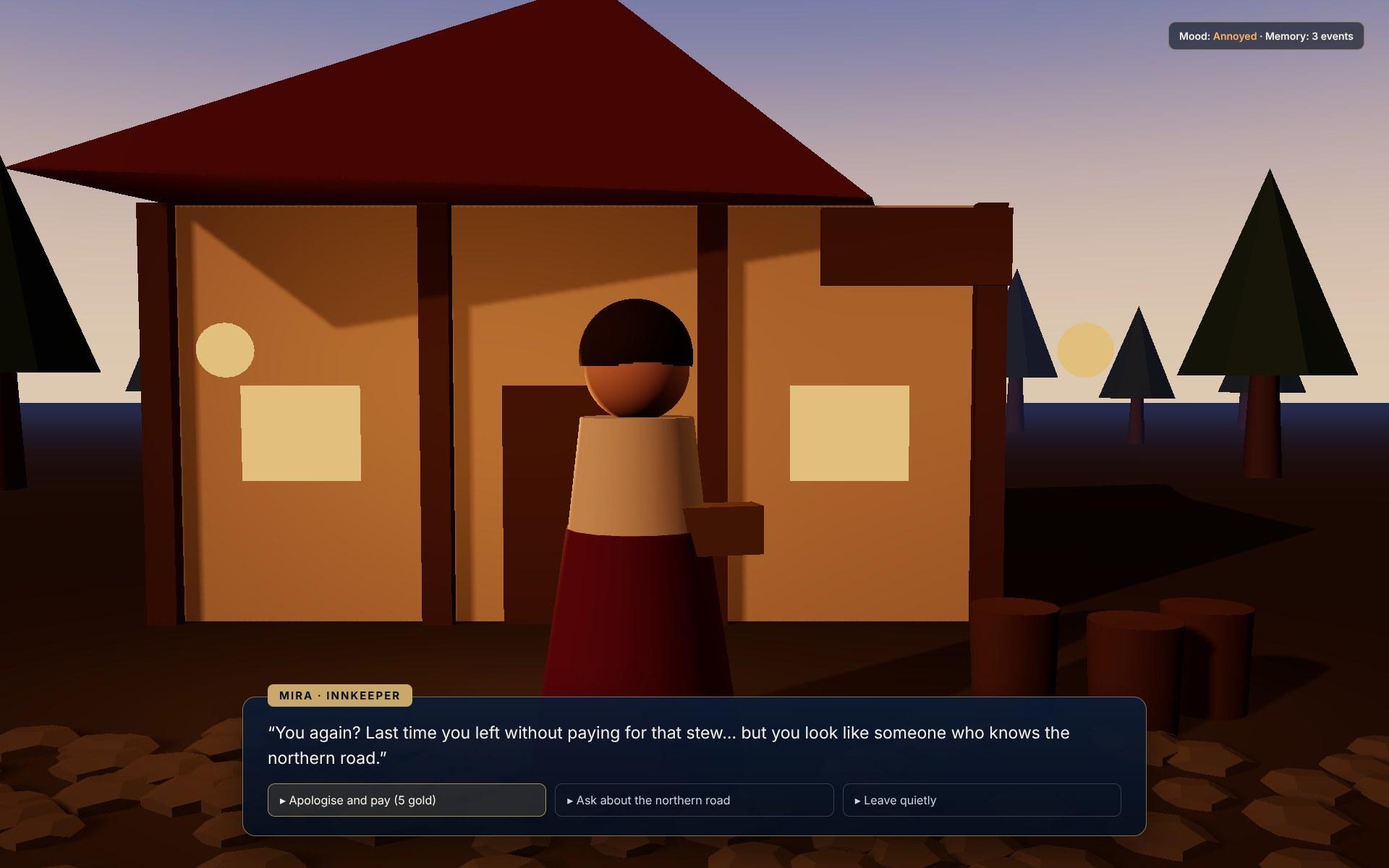
- Language models enable characters that respond to free-form player input.
- Adaptive systems can tune difficulty and pacing to individual players.
- Procedural generation can create varied levels, quests and items.
- AI-assisted tools can speed up testing, localisation and content pipelines.
Design challenges
Players expect consistency. A character that contradicts the story or breaks tone damages immersion. Successful designs constrain AI with world state, character rules and fallback dialogue, and use it where variability genuinely improves the experience.
Latency and cost matter too: a model call that takes seconds may be acceptable in a conversation but not in combat. Many games combine fast traditional systems with slower AI features in carefully chosen moments.
Responsible use of AI-generated assets
Art, music and voice raise licensing and creative questions. We prioritise original and properly licensed assets and are transparent about where AI tools are used in production.
Start with the core loop
AI won't rescue a game that isn't fun. Prototype the core loop first, then add AI where it strengthens what players already enjoy.
Practical AI techniques in games
- Pathfinding (such as A*) for movement through levels.
- Finite state machines for simple, readable enemy behaviour.
- Behaviour trees for complex, modular character logic.
- Utility AI for characters that weigh several needs and choose the best action.
- Procedural generation for levels, loot and terrain.
- Language models for open-ended dialogue and narrative variation.
AI in the development pipeline
Beyond gameplay, AI tools increasingly support production: automated playtesting bots that find bugs and balance issues, assistance with localisation drafts, and tooling that helps designers generate variations to review. The key is keeping humans in charge of creative decisions and quality.
Performance and cost
Real-time games run at many frames per second, so in-game AI must be efficient. Cloud model calls add latency and per-use costs, which is why they are best reserved for moments such as conversations or between-level generation. On-device models are improving but must fit the memory and power budget of the target platform.
Frequently asked questions
Can AI generate a whole game?
Not in a way that replaces design. AI helps with parts of production, but compelling games still depend on human creative direction.
Are AI NPCs ready for commercial games?
Constrained AI dialogue is viable in the right genres; it needs careful design, testing and cost planning.
Which engine is best for AI-driven games?
Unity, Unreal and Godot all support AI systems; the best choice depends on platform, team skills and project scope.