Start with a painful, specific problem
Successful AI products rarely start with ‘let's use AI’. They start with a specific user who has a frequent, expensive problem. AI is then one ingredient in solving it — alongside good workflow design, integrations and a clear interface.
Decide what makes your product defensible
If your product is only a thin layer over a public AI model, competitors can copy it quickly. Durable products add something harder to replicate: proprietary workflows, integrations, domain data, trust, or a superior user experience.
The core building blocks
- Authentication, organisations and roles — usually multi-tenant from day one.
- Subscription billing with trials, plans and usage limits.
- The core workflow that delivers your product's main outcome.
- AI features with clear inputs, editable outputs and cost controls.
- An admin area for support, usage monitoring and configuration.
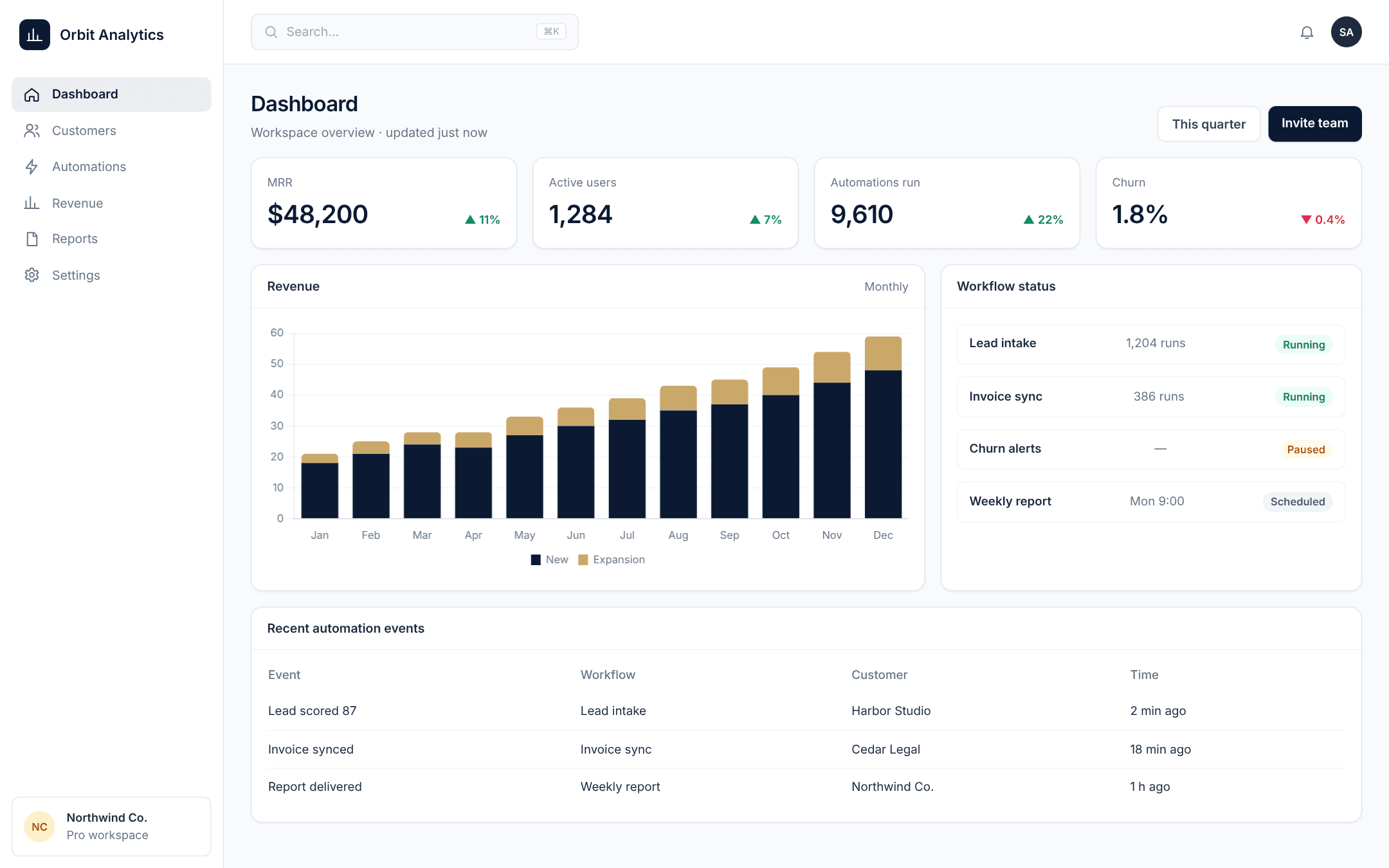
- Analytics to understand activation and retention.
Design AI features for trust
Users trust AI features more when they can see sources, edit results and undo actions. Show progress while the model works, explain limitations, and make it easy to report a bad output. These details often matter more than the choice of model.
Plan for AI costs early
Model usage is a variable cost that grows with every customer. Estimate cost per user action, choose models per task, cache where possible and align pricing tiers with usage. Margins are much easier to design upfront than to repair later.
Launch, learn, iterate
Ship a focused first version to a small group of real users, watch where they get stuck and iterate quickly. The roadmap after launch should be driven by evidence, not by the original feature list.
Choosing a technical foundation
For most AI SaaS products a modern web stack is the right choice: a TypeScript front end, a server layer for business logic and AI calls, a managed relational database and a reliable authentication provider. This combination is well understood, easy to hire for and scales comfortably to thousands of customers.
Keep the AI layer modular. Wrap model calls in your own service with logging, retries and usage tracking, so you can switch providers or models as prices and capabilities change without rewriting your product.
Multi-tenancy and data separation
Most B2B SaaS products serve many organisations from one platform. Every query must be scoped to the right tenant, and AI features must never retrieve another customer's data. Building this into the data model from the start is far easier and safer than adding it later.
Pricing an AI product
- Per-seat pricing is simple but can hide heavy AI usage by a few users.
- Usage-based pricing aligns cost and revenue but is harder for buyers to predict.
- Tiered plans with included usage and fair-use limits are a practical middle ground.
- Whatever you choose, measure cost per active customer every month.
A realistic launch timeline
A focused first version — authentication, billing, the core workflow and one or two AI features — can often be designed and built in two to three months. Larger platforms with integrations, complex permissions or heavy data processing take longer. Plan for a short private beta before public launch; real users will reveal priorities no specification can predict.
Frequently asked questions
Should I build on top of a public AI model?
Usually yes. Fine-tuning or training your own model is rarely necessary at the start; your advantage comes from workflow, data and experience.
How do I protect customer data?
Use providers that don't train on your data, separate tenants strictly, encrypt data and document data flows for customers.
What should I build first?
The single workflow that delivers your product's main outcome, plus just enough onboarding and billing to test willingness to pay.