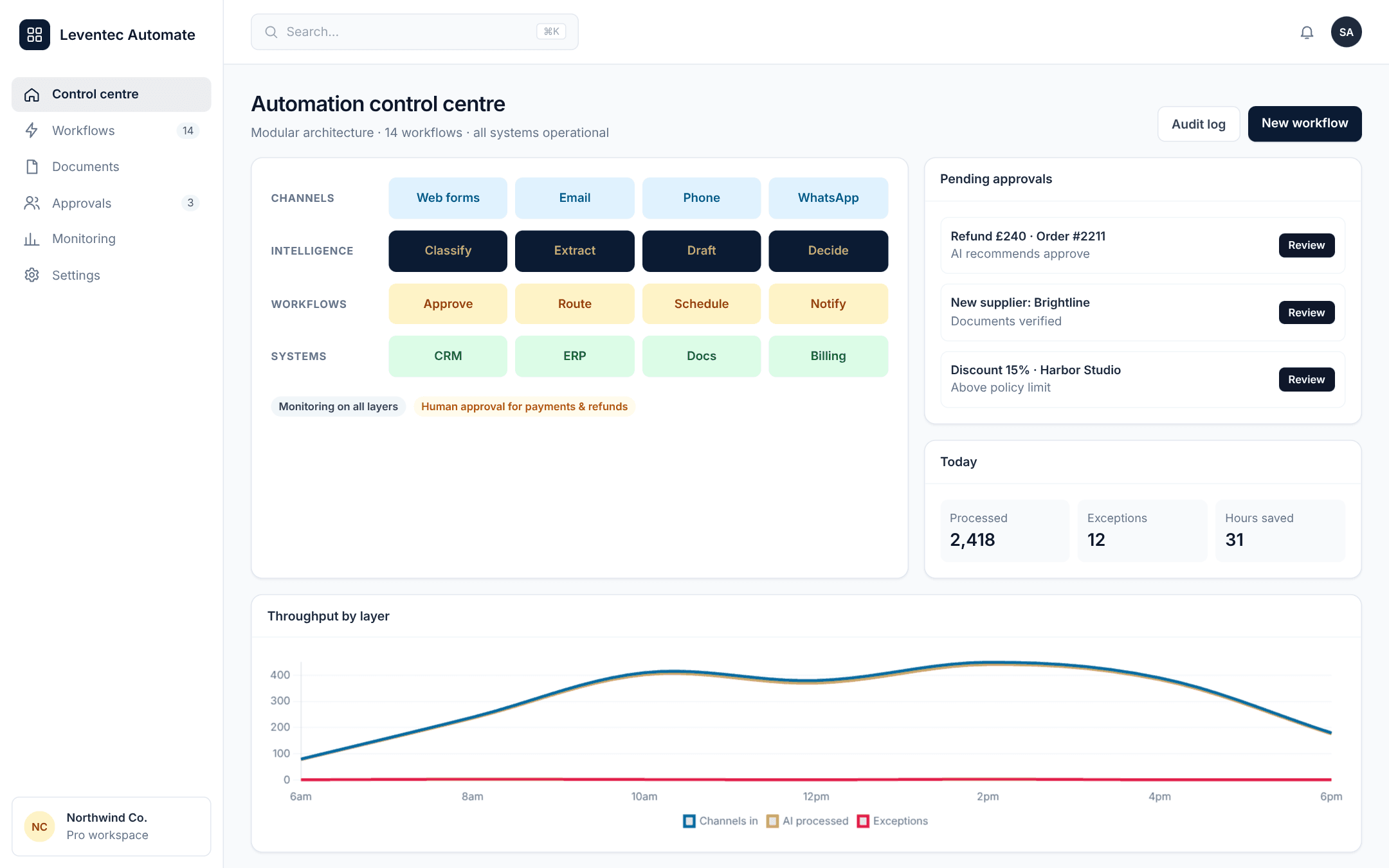
Automation and AI are not the same thing
Traditional automation follows rules: when a form is submitted, create a contact and send an email. It is predictable, cheap and reliable. AI adds the ability to handle work that rules can't describe well — reading an email to understand intent, extracting fields from a messy document, or drafting a reply.
The most effective systems combine both. Rules handle the structure and AI handles the judgement, with validation in between. Treating AI as a replacement for every rule usually makes systems slower, costlier and harder to trust.
Where AI automation creates real value
- High-volume, repetitive work that still needs some reading or interpretation — triaging enquiries, classifying tickets, processing documents.
- Response speed — answering enquiries in minutes instead of hours, outside working hours.
- Consistency — applying the same checks and formats every time.
- Freeing skilled people from administrative work so they can focus on clients.
Start with the process, not the tool
Before choosing a platform, map the process as it really happens today. Who touches it, where does it wait, what goes wrong? The best first automation is usually a narrow, frequent task with a clear definition of done.
Define success in plain terms — for example, ‘every website enquiry receives a relevant reply within five minutes’ — and measure it before and after.
Keep people in the loop
For anything consequential — pricing, refunds, medical or legal information — design an approval step. AI can prepare the work, but a person confirms it. As confidence grows, approval rules can be relaxed where the data supports it.
A practical first step
List the five tasks your team repeats most each week. For each, note the volume, the time it takes and the cost of a mistake. The task with high volume and low risk is usually the right place to begin.
Common AI automation examples
- Enquiry triage: read incoming emails or form submissions, detect intent and urgency, and route them to the right person with a suggested reply.
- Document processing: extract names, dates, amounts and line items from invoices, contracts or application forms and push them into your systems.
- Meeting and call summaries: turn transcripts into action items and CRM notes automatically.
- Customer messaging: answer common questions on your website or WhatsApp and escalate the rest.
- Reporting: gather figures from several tools and write a plain-language weekly summary.
How to estimate the value
A simple model works for most businesses: multiply how often a task happens by how long it takes and by the hourly cost of the people doing it. Then add the cost of delays and errors — a lead that waits a day for a reply, or an invoice keyed in incorrectly. Compare that annual figure to the cost of building and running the automation.
Be conservative. Assume the automation handles most, not all, cases, and that some work moves to reviewing outputs rather than disappearing. Projects that still look worthwhile under cautious assumptions are the ones to start with.
Mistakes to avoid
- Automating a broken process — fix the steps first, then automate them.
- Choosing tools before defining the outcome you want.
- Skipping error handling, so failures go unnoticed for weeks.
- Letting AI send sensitive messages without review in the early stages.
- Not assigning an owner who is responsible for the automation after launch.
What a typical first project looks like
A first project usually takes a few weeks from discovery to launch. It begins with a short workshop to map the process, followed by a working prototype tested on real examples. Once the team is comfortable with the results, the automation goes live with monitoring in place, and the next opportunity is chosen based on what was learned.
Frequently asked questions
Do I need technical staff to use AI automation?
No. A well-designed automation runs in the background. You need someone who owns the process and reviews results, not someone who writes code.
Is AI automation expensive to run?
Running costs depend on volume and the AI models used. Many automations cost little to operate; we estimate costs before building.
Will AI replace my team?
In most businesses it removes repetitive work so people can focus on clients, judgement and relationships.